

Table of Contents
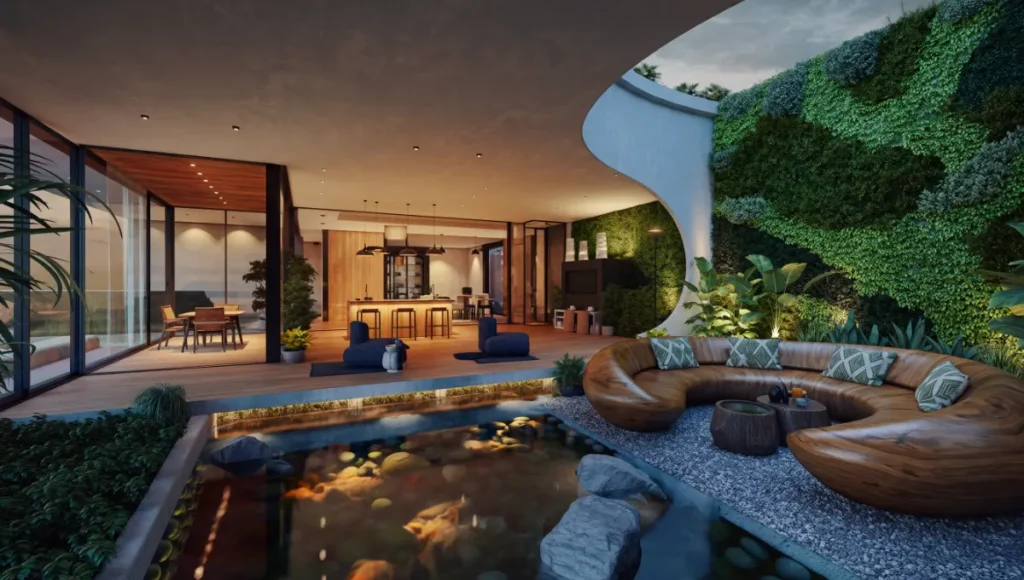
In an era of hyper-urbanization and digital saturation, the concept of Biophilic Interior Design has transitioned from a luxury aesthetic to a biological imperative. As our species spends upwards of 90% of its existence indoors, the “nature deficit” is no longer a poetic metaphor—it is a documented physiological crisis. Urban environments, characterized by right angles, sterile surfaces, and high-frequency noise, force the human brain into a state of “high-beta” brainwave activity—a persistent “fight or flight” mode that erodes cognitive performance and physical health.
Nuvira Perspective: The Home as a Health Machine
At Nuvira Space, we view the traditional concept of “decor” as an obsolete relic of the 20th century. To us, your living environment is not a collection of static furniture; it is a sophisticated human-machine interface designed to regulate your nervous system. We advocate for the evolution of the home into a “health machine”—a modular, responsive ecosystem where biophilic interior design serves as the operating system.
By integrating circadian synchronization and adaptive spatial geometry, we move beyond passive beauty toward an active, neuro-architectural synthesis. We treat stress not as a lifestyle inevitability, but as a design flaw to be engineered out of existence through the seamless integration of biological intelligence and technological precision.
Technical Deep Dive: The Neuro-Architecture of Biophilia
Biophilic interior design functions by triggering the Parasympathetic Nervous System (PNS). When you interact with natural geometries, your brain recognizes “fractal fluencies”—patterns that repeat at different scales—which reduce cognitive load and lower cortisol levels.
1. Fractal Geometry and Visual Complexity
Unlike the sterile, linear boxes of mid-century modernism, biophilic design utilizes organized complexity.
- Technical Spec: 1.3 to 1.5 fractal dimension (D). This specific range, found in fern fronds, coastlines, and cloud formations, is the “sweet spot” for human visual processing.
- Biological Impact: Studies show that viewing mid-range fractals triggers a “fluency” in the visual cortex, allowing the brain to relax because it can predict the pattern without heavy processing power.
- Nuvira Application: We utilize CNC-milled wall panels and flooring systems that mimic the mathematical distribution of forest floor patterns rather than repetitive, soul-crushing grids.
2. Circadian Synchronization (Non-Rhythmic Sensory Stimuli)
Static environments lead to sensory deprivation. A “health machine” must simulate the subtle, non-rhythmic shifts of the natural world.
- Technical Spec: High-CRI (Color Rendering Index >95) LED systems programmed to follow the Kelvin scale of natural daylight (2700K to 6500K).
- Biological Impact: Regulation of the suprachiasmatic nucleus (SCN) to ensure melatonin suppression during the day and secretion at night.
- Nuvira Application: Implementation of dynamic light filtration—mirrors and automated louvers—that mimics “komorebi” (the dappled light effect found under a tree canopy).
3. Thermal and Airflow Variability
Uniform temperatures (the standard 21°C/70°F) are biologically unnatural. Subtle fluctuations in airflow keep the mind alert yet calm.
- Technical Spec: Cross-ventilation rates of 0.3 m/s to 0.5 m/s.
- Biological Impact: Avoiding “sick building syndrome” and metabolic stagnation.
- Nuvira Application: Utilization of hygroscopic materials like raw clay plaster or cross-laminated timber (CLT) to regulate humidity naturally and provide tactile thermal feedback.
4. The Presence of Water (Auditory and Visual)
The sound of water is the ultimate pink noise. It masks urban dissonance and grounds the inhabitant in a primordial sense of safety.
- Technical Spec: 45-55 dB acoustic range for water features.
- Biological Impact: Induces alpha-wave brain states associated with relaxation and creative insight.
Macro-Environmental Case Study: Singapore’s “City in a Garden”
To understand the scalability of biophilic interior design, one must look at Singapore. The city-state’s “Landscape Replacement Policy” mandates that any greenery lost to development must be replaced within the architecture itself.
In projects like the Parkroyal Collection Pickering and the Khoo Teck Puat Hospital, biophilic design isn’t just for aesthetics; it is a clinical intervention. The integration of over 700 species of plants and tiered water features has been linked to lower blood pressure in patients and higher staff retention. This proves that when the macro-environment adopts biophilic principles, the micro-environment (the home) becomes a seamless extension of a restorative urban fabric. It demonstrates that we can “re-wild” our interior existence without sacrificing urban density.
Comparative Analysis: Nuvira Standards vs. Industry Standards
| Feature | Industry Standard Decor | Nuvira Biophilic Engineering |
|---|---|---|
| Vegetation | Decorative potted plants (Passive) | Hydroponic living walls (Active Bio-filtration) |
| Lighting | Fixed 3000K “Warm White” bulbs | Automated Circadian Spectral Tuning |
| Air Quality | HEPA filtration (Mechanical) | Phyto-remediation via plant-microbe symbiosis |
| Materials | Synthetic veneers and plastics | Biomorphic textures (Haptically active) |
| Acoustics | Foam sound panels (Hidden) | Diffuse acoustic moss or cork (Visible/Organic) |
| Geometry | Rigid 90-degree corners | Fractal & Biomorphic contours |
Concept Project Spotlight: Speculative Internal Concept Study “Aetheris Synthesis” by Nuvira Space
Project Overview
- Location: Rijnhaven District, Rotterdam, Netherlands
- Typology: Adaptive Neuro-Architectural Residential Complex
- Vision: Transforming urban high-density living into a “Health Machine” ecosystem.
Design Levers Applied
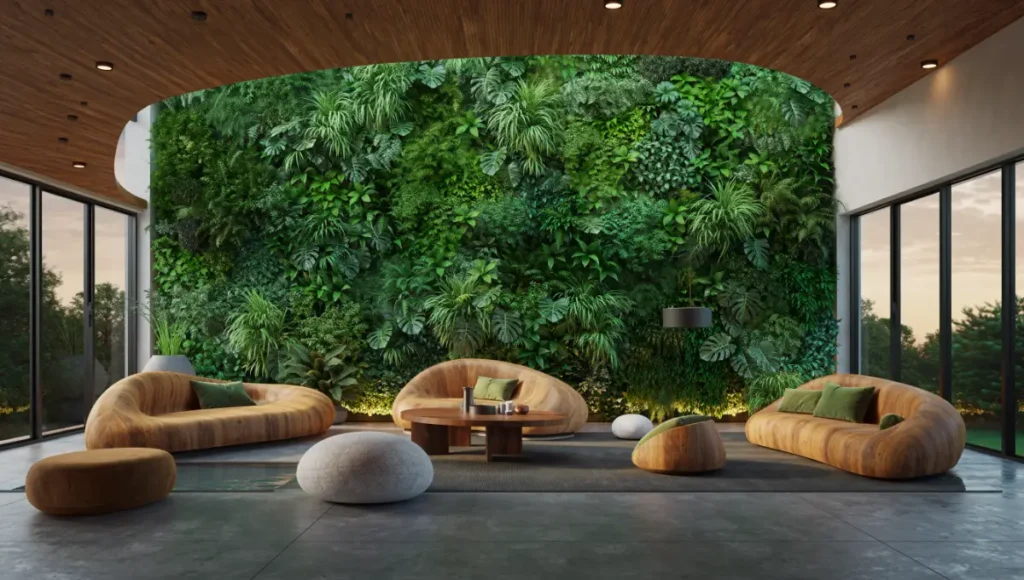
The Aetheris Synthesis utilizes a “Modular Skin” approach to Biophilic Interior Design.
- Technical Spec: 22% of total interior surface area dedicated to active biological interfaces (mycelium insulation and hydroponic skin).
- Atmospheric Regulation: Integrated VOC sensors trigger localized airflow increases (0.6 m/s) when digital toxicity is detected.
- Spatial Geometry: The floor plan follows a “Fibonacci Layout,” ensuring no two walls meet at a standard 90-degree angle, eliminating visual harshness.
Transferable Takeaway
You can apply the same logic at home by tuning evening lighting to amber hues, building a refuge corner with a high-backed textured chair, and simplifying one primary sightline toward a natural anchor—even if that anchor is a single, high-quality botanical focal point or a window view.
Intellectual Honesty: Current Limitations
While the benefits of biophilic interior design are scientifically backed, we must address the “green-washing” of the industry.
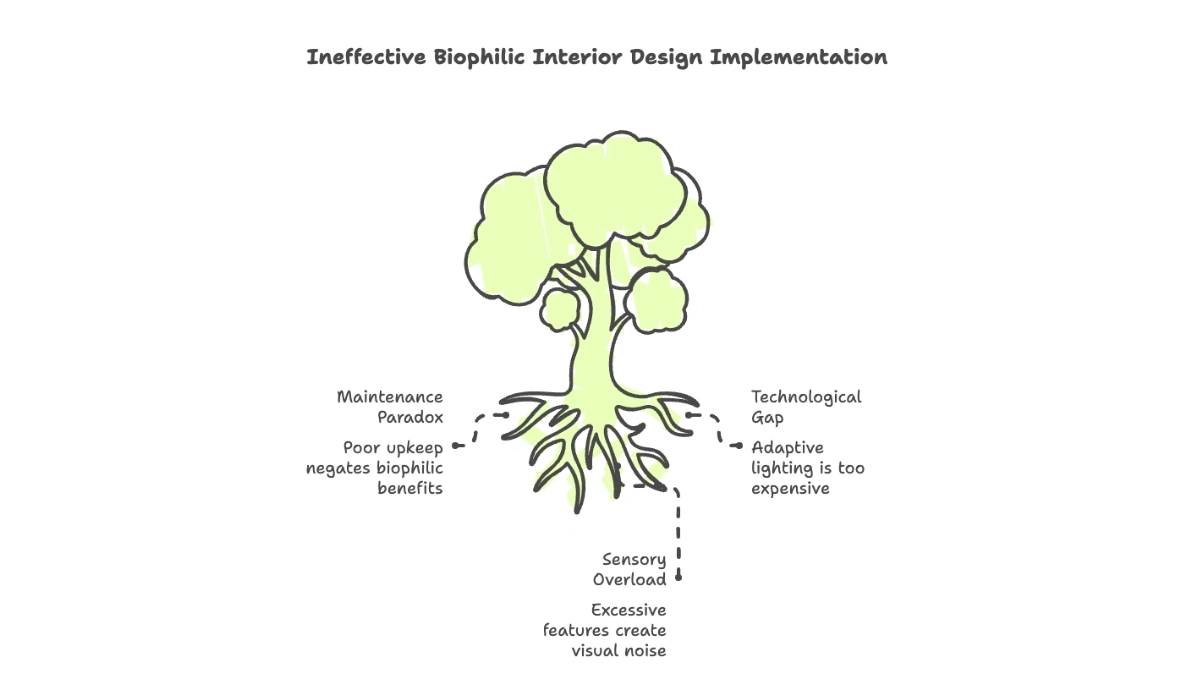
- The Maintenance Paradox: High-density living walls require complex irrigation systems. If poorly managed, they lead to mold and moisture issues—the literal antithesis of a “health machine.” True biophilia requires a commitment to stewardship, not just a one-time purchase.
- The Technological Gap: Truly adaptive circadian lighting that accounts for specific latitude and seasonal shifts is still cost-prohibitive for the mass market. We are currently in an “early adopter” phase where true spatial biology is a bespoke service.
- Sensory Overload: There is a risk of “over-designing.” If every surface is a fractal and every corner has a water feature, the environment becomes visually noisy. The key is “organized complexity,” not chaos.
2030 Future Projection: The Responsive Habitat
By 2030, we predict the “Living Space” will become truly sentient. We are moving toward Synthetic Biophilia, where algae bio-curtains and bio-luminescent systems provide ambient light, dynamic shading, and active carbon sequestration—turning facades and interiors into living bioreactors. Self-healing materials will mimic skin, while biomass-powered filtration blurs the line between nature and machine.
Your home will function as a wearable at scale. By integrating with your biometric data, the habitat will sense an elevated heart rate and automatically adjust the olfactory landscape (releasing phytoncides), humidity, and acoustic frequency to induce a “flow state.” We grow furniture from mycelium and power air filtration through bioluminescent flora.
Actionable Design Principles: 7 Iconic Ways to Reduce Stress
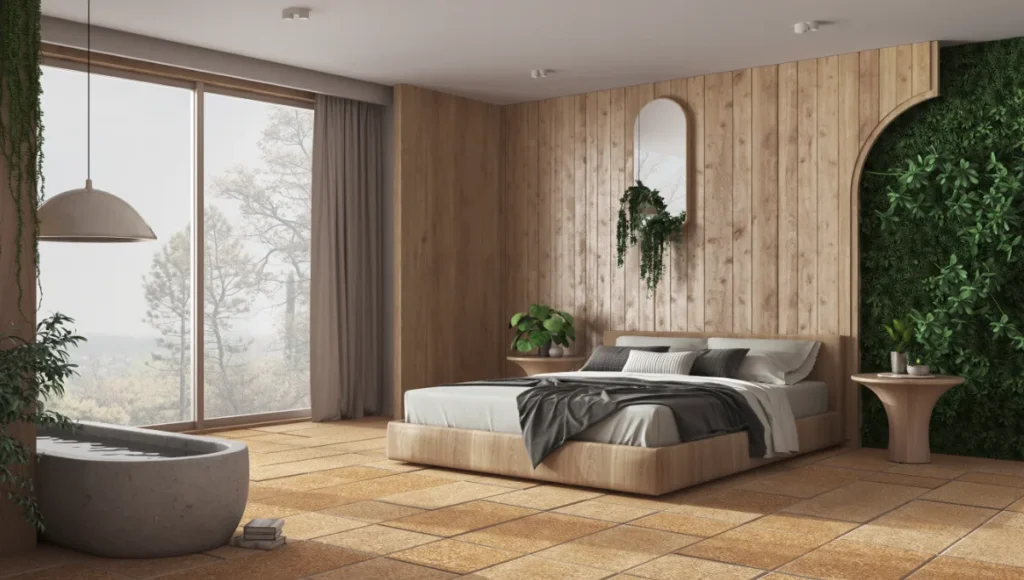
1. Prioritize Prospect and Refuge
This is an evolutionary survival mechanism. We feel safest when our back is protected (Refuge) but we have a wide view of our surroundings (Prospect).
- Action: Position your bed or desk so you can see the door and the window without being in the direct “line of fire.” Use high-backed chairs to anchor your workspace.
2. Integrate “Living” Materials (Haptics)
Avoid synthetic “touch-neutral” materials.
- Action: Use cork, rattan, untreated timber, or stone. These materials possess a “patina”—they age and change, reminding our subconscious of the passage of time and the cycle of life.
3. Harness the Power of Water
- Action: You don’t need a waterfall. A small, recirculating stone basin provides the necessary “Pink Noise” to mask the hum of the refrigerator or the siren on the street.
4. Embrace Biomorphic Forms
Nature does not do straight lines.
- Action: Introduce curved sofas, arched doorways, or oval mirrors. Softening the sharp edges of a room reduces the “visual aggression” of the space.
5. Curate Olfactory Landscapes
- Action: Use essential oil diffusion systems that mimic “Shinrin-yoku” (forest bathing). Focus on cedarwood, cypress, and pine—these contain phytoncides that naturally lower cortisol.
6. Maximize View Corridors
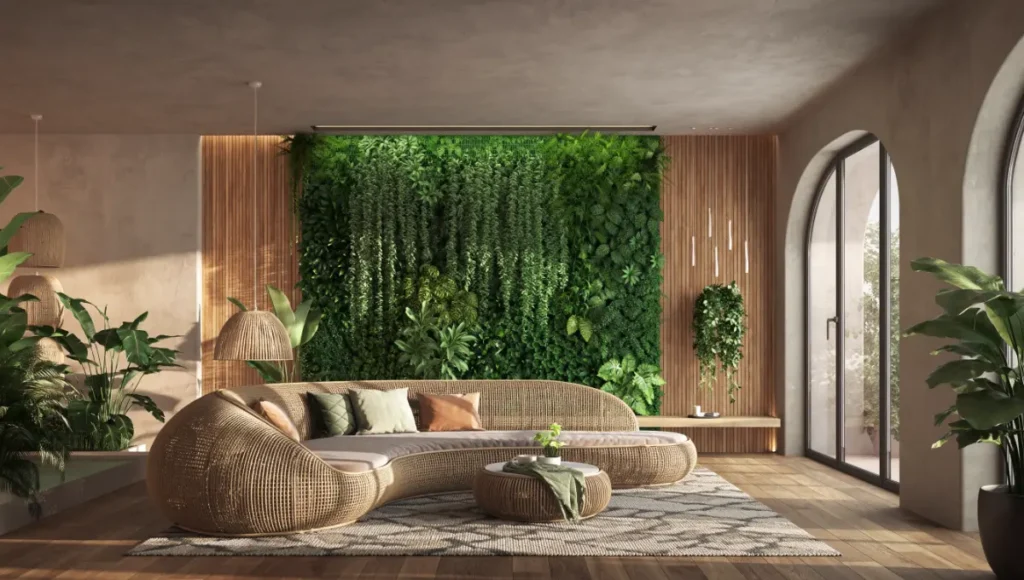
- Action: Ensure your primary eye-level sightlines end in a natural element—be it a tree outside, a large-scale nature photograph, or a living wall.
7. Implement Sensory Zoning
- Action: Designate one corner of your home as a “Zero-Digital Zone.” No screens, no LEDs. Use only organic materials and natural light to create a ritualistic transition from “work” to “rest.”
Comprehensive Technical FAQ
Q: Does biophilic design require a high budget for plants?
A: No. Biophilia is about patterns as much as plants. You can achieve significant stress reduction through:
- Maximizing natural light exposure via strategic mirror placement.
- Using fractal-patterned textiles or wallpapers.
- Introducing natural colors (terracotta, sage, ochre) that mimic the earth’s palette.
Q: How do living walls impact indoor air quality (IAQ)?
A: Active living walls are more than decor; they are biological filters.
- CO2 Reduction: They can reduce CO2 levels by 10%–25% in enclosed rooms.
- VOC Filtration: Plants like Pothos and Peace Lilies filter formaldehyde and benzene through their roots and soil microbes via a process called phyto-remediation.
Q: Can biophilic interior design work in windowless apartments?
A: Yes, through “Analog Biophilia.” This involves:
- Full-spectrum artificial lighting with automated Kelvin shifting.
- High-definition digital art displaying nature footage.
- Heavy use of natural materials like stone and wood to provide tactile grounding.
Q: What is the most important element for a home office?
A: Circulation and “Prospect.” If you are staring at a wall while working, your brain enters a “closed-loop” state. Orient your desk toward a window or a long sightline to allow for “soft fascination,” which restores directed attention.
Evolve Your Environment
The future of living is not about how your home looks to others; it is about how it makes you function. We are moving past the era of the “house” and into the era of the “restorative sanctuary.”
If you are ready to transition from a static apartment to a high-performance health machine, Nuvira Space is here to engineer your evolution. Stop decorating. Start synthesizing.
2 thoughts on “Biophilic Interior Design: 7 Iconic Ways to Reduce Stress”